Description
Note: Many products are not yet listed. Please contact us for more product information. Our supply channels are constantly expanding, and we currently have 20 stable shared supply channels. Please confirm the model, product, price, and all other necessary information with customer service before placing an order. We offer new, refurbished, and used products, and prices are adjusted according to the year of the item you require.
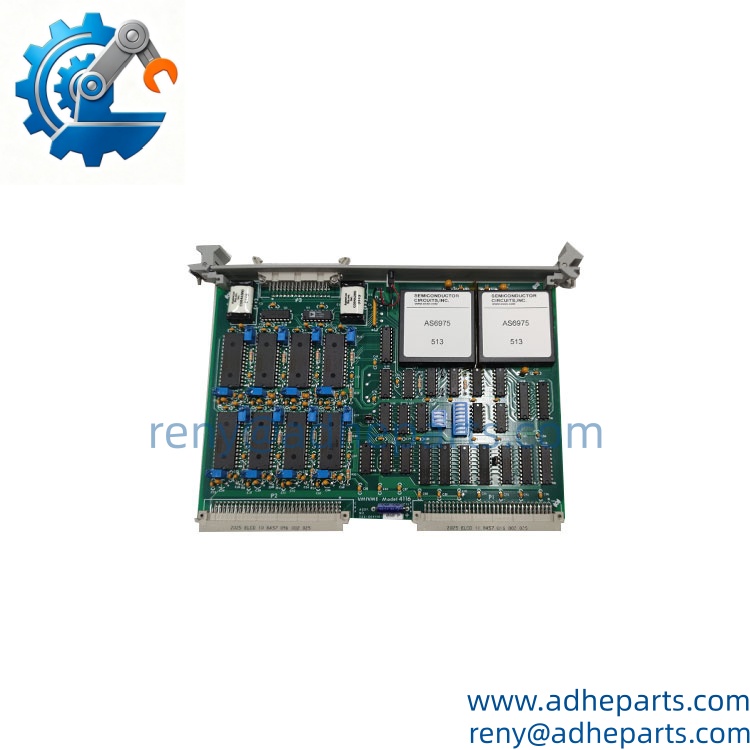
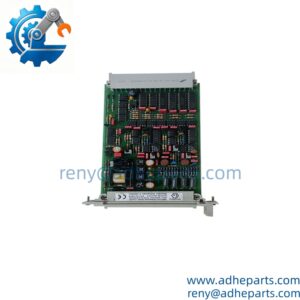
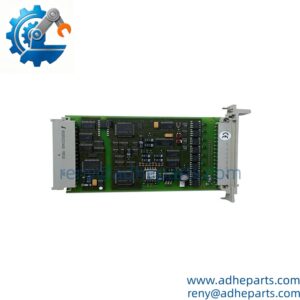
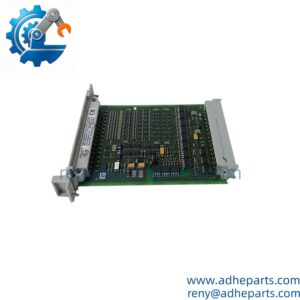
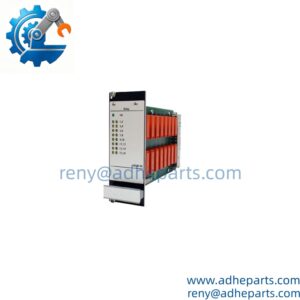
GE VMIVME-4116
Key Technical Specifications
| Parameter | Specification |
|---|---|
| Model | VMIVME-4116 |
| Product Type | 8-Channel Analog Output Board |
| Conversion | Digital-to-Analog |
| Resolution | 16-bit |
| Number of Channels | 8 |
| Output Range | -10 V to +10 V |
| Output Current | 5 mA |
| VMEbus Data Transfer | A16/D8, D16 |
| Output Settling Time | 10 µs to ±1/2 LSB |
| Differential Linearity Error | ±0.003% FSR |
| Linearity Error | ±0.0015% FSR |
| Gain Drift | ±10 ppm/°C |
| Zero Drift | ±5 ppm FSR/°C |
| Power Requirement | 2.5 A maximum at +5 V |
| Operating Temperature | 0 to +50°C |
| Storage Temperature | -20 to +85°C |
| Dimensions | 6U × 160 × 233.35 mm |
| VME Connectors | Two 96-pin DIN connectors |
| Output Connector | P3 |
| Board Address | 12 DIP switches |
The standard VMIVME-4116 provides eight buffered analog outputs. The 16-bit conversion gives an approximately 305 µV/LSB resolution over the ±10 V bipolar range.
Several factory configurations were offered, including versions with JFET output isolation switches, output isolation relays, and Built-In-Test hardware. Therefore, the suffix or exact ordering configuration should be checked before replacing an installed board.
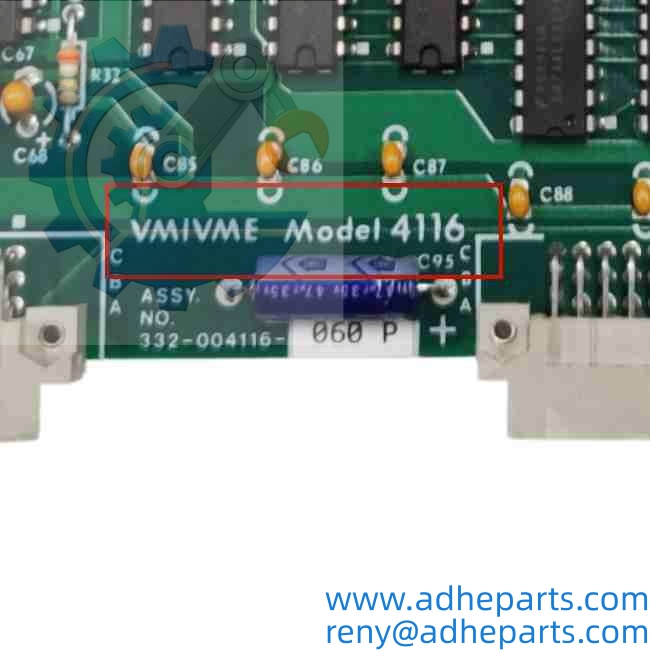
Product Introduction — Anti-Template
The GE VMIVME-4116 is built for VME-based systems that need controlled analog voltage generation rather than signal acquisition. Eight independent 16-bit DAC channels produce buffered outputs across the -10 V to +10 V range, while double-buffered data latches allow output updates to be coordinated instead of changing channels one at a time.
The board also supports VMIC’s analog expansion and Built-In-Test architecture through the P2/AMXbus interface. Depending on the exact configuration, output isolation and test circuitry may be installed. (That distinction matters when sourcing a replacement—the basic board number alone may not tell the whole story.)
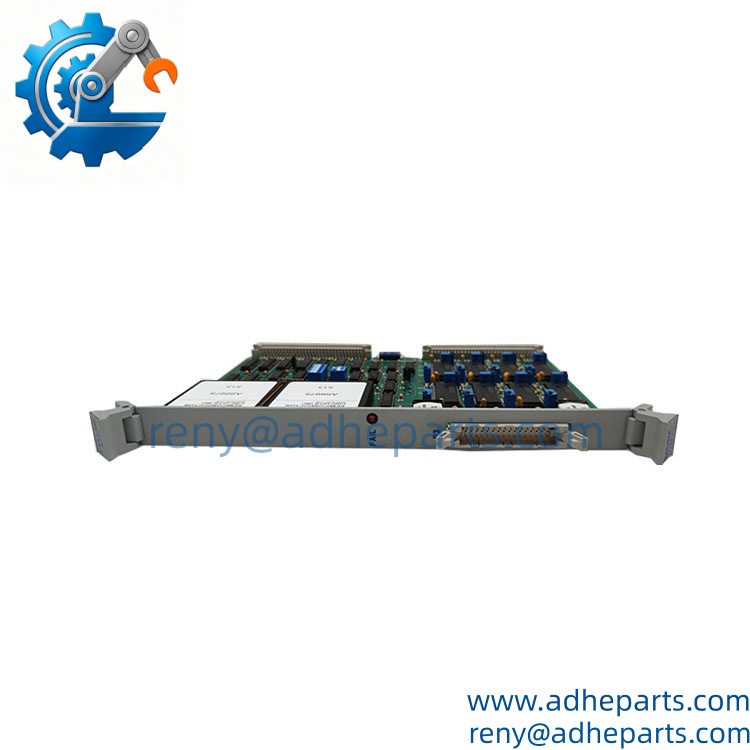
GE VMIVME-4116
QC, Procurement & Logistics SOP
1) Inbound Verification
Before accepting a VMIVME-4116 into stock, verify:
- Complete model number and any suffix or configuration marking.
- PCB revision and identification labels.
- VME P1/P2 connector condition.
- P3 analog output connector condition.
- DIP-switch settings and jumper positions.
- Signs of corrosion, previous repair, overheating, or damaged components.
- Presence or absence of output isolation hardware.
The original documentation specifies that the board address is selected using 12 DIP switches, while operating modes and update behavior also depend on board configuration.
2) Functional Testing
A proper test should verify:
- VMEbus communication.
- Recognition of the board address.
- All eight DAC channels.
- Positive and negative output voltage.
- Output settling behavior.
- Synchronized channel updates.
- Reset behavior.
- Fail LED operation.
- Isolation/test functions where fitted.
The original design initializes the analog outputs to 0.0 V during reset; boards equipped with isolation switches or relays can also disconnect the field outputs during reset.
3) QA & ESD Packaging
The board should be handled as an ESD-sensitive electronic assembly.
Recommended shipment preparation:
- Visual inspection and serial-number recording.
- Functional test report where available.
- ESD-safe packaging.
- Connector protection.
- Anti-shock inner cushioning.
- Rigid export carton.
- Moisture protection for extended international transport.
4) Global Logistics
For international orders, confirm the exact board configuration before preparing the commercial invoice and packing list.
The VMIVME-4116 is a relatively large 6U VME Eurocard, so package dimensions and protective packing can materially affect freight cost. The board itself is approximately 160 × 233.35 mm, excluding external packaging.
For urgent replacement requirements, air express is generally practical for a single board; larger quantities can be consolidated for air freight.
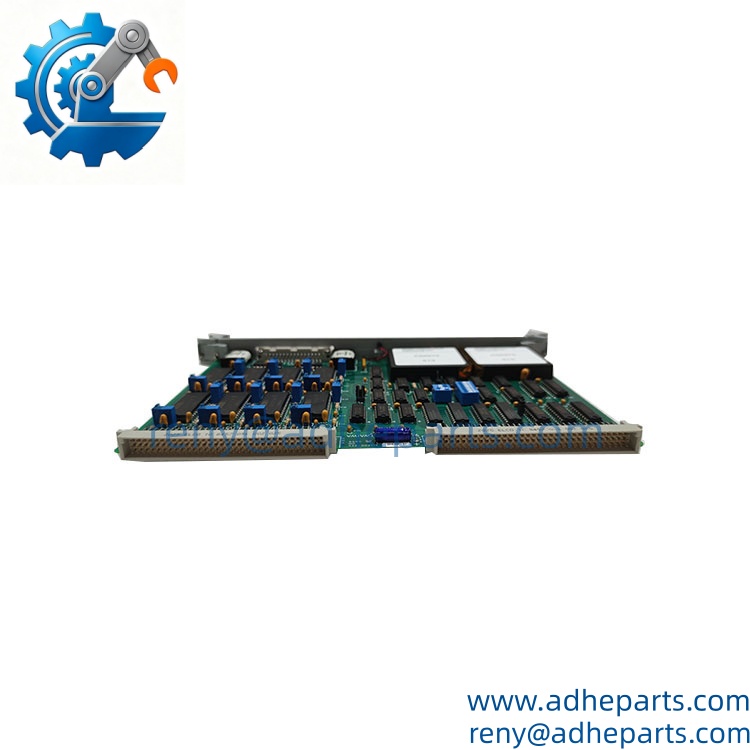
GE VMIVME-4116
Technical Pitfalls & Integration Warnings
1) Do not confuse it with an analog input board
This is the most important identification issue. VMIVME-4116 is an analog output/DAC board, not a 64-channel analog input board. Some third-party listings incorrectly assign ADC specifications to this model. The manufacturer’s datasheet clearly specifies eight 16-bit analog output channels.
2) Check the exact suffix and hardware configuration
The family was supplied in multiple configurations, including models with JFET isolation, relay isolation, and Built-In-Test hardware. A physically similar replacement may therefore have different field-interface behavior.
3) DIP-switch and jumper settings must match
The board uses DIP switches for VMEbus addressing, while jumpers determine aspects of access and update operation. A replacement board that powers up but has a different address or configuration can still fail to operate correctly in the existing application.
4) Watch the load impedance with isolated versions
The Built-In-Test versions can place isolation switches in series with the analog output. The documented JFET configuration has approximately 100 Ω maximum ON resistance, which can introduce voltage-divider error with low-impedance loads. The manufacturer’s example shows why load impedance needs to be considered during integration.
5) Confirm P2/AMXbus requirements
The P2 connector can participate in VMIC’s analog test and expansion architecture. If the original system uses AMXbus-related testing, replacing the board with a configuration that lacks the required test hardware can change the system’s diagnostic capability.
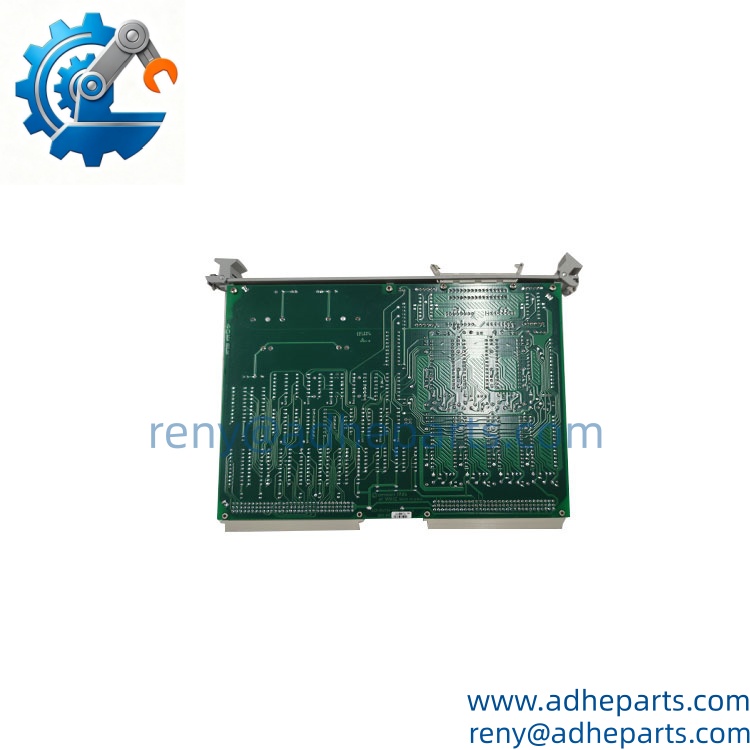
GE VMIVME-4116
Frequently Asked Questions
Q1. What is the GE used for?
It is an 8-channel, 16-bit analog output board used in VMEbus systems to convert digital commands into bipolar analog voltage signals.
Q2. What is the output range of the ?
The documented output range is -10 V to +10 V, with a maximum output capability of approximately 5 mA.
Q3. Is an ADC or DAC board?
It is a DAC board — Digital-to-Analog Converter. The eight channels each use a 16-bit DAC.
Q4. How many channels does have?
It has 8 analog output channels.
Q5. What VMEbus format does the use?
It is a double-height VMEbus board using two 96-pin DIN VME connectors, with A16/D8 and D16 data-transfer modes documented for the board.
Q6. Does every have output isolation?
No. Different factory configurations were available, including versions without isolation and versions using JFET switches or output isolation relays. Check the exact model configuration before ordering.
Q7. What should I send when requesting a replacement?
Provide the complete label, revision/configuration suffix, quantity, and photos of the PCB and connectors. If possible, also provide the existing VME chassis and application information. This is particularly useful because the 4116 family includes different isolation and Built-In-Test configurations.
Pre: Motorola VME172PA-652SE | 50 MHz VMEbus Controller, Available
Next: GE VMIVME-7750 | VMEbus Rev C.1 Single Slot Processor | PMC Expansion Ready